


Logarithms were introduced by John Napier in the early 17th century as a means to simplify calculations. They were rapidly adopted by navigators, scientists, engineers, and others to perform computations more easily, using slide rules and logarithm tables. Tedious multi-digit multiplication steps can be replaced by table look-ups and simpler addition because of the fact—important in its own right—that the logarithm of a product is the sum of the logarithms of the factors:

Logarithmic scales reduce wide-ranging quantities to smaller scopes. For example, the decibel is a unit quantifying signal power log-ratios and amplitude log-ratios (of which sound pressure is a common example). In chemistry, pH is a logarithmic measure for the acidity of an aqueous solution. Logarithms are commonplace in scientific formulae, and in measurements of the complexity of algorithms and of geometric objects called fractals. They describe musical intervals, appear in formulae counting prime numbers, inform some models in psychophysics, and can aid in forensic accounting.
In the same way as the logarithm reverses exponentiation, the complex logarithm is the inverse function of the exponential function applied to complex numbers. The discrete logarithm is another variant; it has uses in public-key cryptography.
Motivation and definition
The idea of logarithms is to reverse the operation of exponentiation, that is raising a number to a power. For example, the third power (or cube) of 2 is 8, because 8 is the product of three factors of 2:
Exponentiation
The third power of some number b is the product of three factors of b. More generally, raising b to the n-th power, where n is a natural number, is done by multiplying n factors of b. The n-th power of b is written bn, so that
Definition
The logarithm of a positive real number x with respect to base b, a positive real number not equal to 1[nb 1], is the exponent by which b must be raised to yield x. In other words, the logarithm of x to base b is the solution y to the equation[2]
Examples
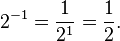
For example, log2(16) = 4, since 24 = 2 ×2 × 2 × 2 = 16. Logarithms can also be negative:
Logarithmic identities
Main article: List of logarithmic identities
Several important formulas, sometimes called logarithmic identities or log laws, relate logarithms to one another.[3]Product, quotient, power and root
The logarithm of a product is the sum of the logarithms of the numbers being multiplied; the logarithm of the ratio of two numbers is the difference of the logarithms. The logarithm of the p-th power of a number is p times the logarithm of the number itself; the logarithm of a p-th root is the logarithm of the number divided by p. The following table lists these identities with examples. Each of the identities can be derived after substitution of the logarithm definitions or
or  in the left hand sides.
| Formula | Example | |
|---|---|---|
| product |  |
 |
| quotient |  |
 |
| power |  |
 |
| root | ![\log_b \sqrt[p]{x} = \frac {\log_b (x)} p](http://upload.wikimedia.org/math/c/5/9/c593efd86930b11a5b737a0d465edb7b.png) |
 |
Change of base
The logarithm logb(x) can be computed from the logarithms of x and b with respect to an arbitrary base k using the following formula: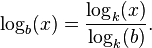


Particular bases
Among all choices for the base, three are particularly common. These are b = 10, b = e (the irrational mathematical constant ≈ 2.71828), and b = 2. In mathematical analysis, the logarithm to base e is widespread because of its particular analytical properties explained below. On the other hand, base-10 logarithms are easy to use for manual calculations in the decimal number system:[5]
The following table lists common notations for logarithms to these bases and the fields where they are used. Many disciplines write log(x) instead of logb(x), when the intended base can be determined from the context. The notation blog(x) also occurs.[9] The "ISO notation" column lists designations suggested by the International Organization for Standardization (ISO 31-11).[10]
| Base b | Name for logb(x) | ISO notation | Other notations | Used in |
|---|---|---|---|---|
| 2 | binary logarithm | lb(x)[11] | ld(x), log(x), lg(x), log2(x) | computer science, information theory, music theory, photography |
| e | natural logarithm | ln(x)[nb 2] | log(x) (in mathematics and many programming languages[nb 3]) |
mathematics, physics, chemistry, statistics, economics, information theory, and some engineering fields |
| 10 | common logarithm | lg(x) | log(x), log10(x) (in engineering, biology, astronomy) |
various engineering fields (see decibel and see below), logarithm tables, handheld calculators, spectroscopy |
History
Predecessors
The Babylonians sometime in 2000–1600 BC may have invented the quarter square multiplication algorithm to multiply two numbers using only addition, subtraction and a table of quarter squares.[15][16] However, it could not be used for division without an additional table of reciprocals (or the knowledge of a sufficiently simple algorithm to generate reciprocals). Large tables of quarter squares were used to simplify the accurate multiplication of large numbers from 1817 onwards until this was superseded by the use of computers.The Indian mathematician Virasena worked with the concept of ardhaccheda: the number of times a number of the form 2n could be halved. For exact powers of 2, this is the logarithm to that base, which is a whole number; for other numbers, it is undefined. He described relations such as the product formula and also introduced integer logarithms in base 3 (trakacheda) and base 4 (caturthacheda)[17]
Michael Stifel published Arithmetica integra in Nuremberg in 1544, which contains a table[18] of integers and powers of 2 that has been considered an early version of a logarithmic table.[19][20]
In the 16th and early 17th centuries an algorithm called prosthaphaeresis was used to approximate multiplication and division. This used the trigonometric identity
![\cos\,\alpha\,\cos\,\beta = \frac12[\cos(\alpha+\beta) + \cos(\alpha-\beta)]](http://upload.wikimedia.org/math/f/a/2/fa244116fc51e7c1bdef9195fd3317e8.png)
From Napier to Euler

John Napier (1550–1617), the inventor of logarithms
Johannes Kepler, who used logarithm tables extensively to compile his Ephemeris and therefore dedicated it to Napier,[25] remarked:
… the accent in calculation led Justus Byrgius [Joost Bürgi] on the way to these very logarithms many years before Napier's system appeared; but … instead of rearing up his child for the public benefit he deserted it in the birth.By repeated subtractions Napier calculated (1 − 10−7)L for L ranging from 1 to 100. The result for L=100 is approximately 0.99999 = 1 − 10−5. Napier then calculated the products of these numbers with 107(1 − 10−5)L for L from 1 to 50, and did similarly with 0.9998 ≈ (1 − 10−5)20 and 0.9 ≈ 0.99520. These computations, which occupied 20 years, allowed him to give, for any number N from 5 to 10 million, the number L that solves the equation
—Johannes Kepler[26], Rudolphine Tables (1627)


The hyperbola y = 1/x (red curve) and the area from x = 1 to 6 (shaded in orange).



Logarithm tables, slide rules, and historical applications

The 1797 Encyclopædia Britannica explanation of logarithms
-
- "...[a]n admirable artifice which, by reducing to a few days the labour of many months, doubles the life of the astronomer, and spares him the errors and disgust inseparable from long calculations."[36]


![\sqrt[d]{c} = c^{\frac 1 d} = b^{\frac{1}{d} \log_b (c)}. \,](http://upload.wikimedia.org/math/b/3/9/b39e1f10bcbdc24bd9bf19bb7d0436b3.png)


Schematic depiction of a slide rule. Starting from 2 on the lower scale,
add the distance to 3 on the upper scale to reach the product 6. The
slide rule works because it is marked such that the distance from 1 to x is proportional to the logarithm of x.
Analytic properties
A deeper study of logarithms requires the concept of a function. A function is a rule that, given one number, produces another number.[40] An example is the function producing the x-th power of b from any real number x, where the base b is a fixed number. This function is written
Logarithmic function
To justify the definition of logarithms, it is necessary to show that the equation
This property can be shown to hold for the function f(x) = bx. Because f takes arbitrarily large and arbitrarily small positive values, any number y > 0 lies between f(x0) and f(x1) for suitable x0 and x1. Hence, the intermediate value theorem ensures that the equation f(x) = y has a solution. Moreover, there is only one solution to this equation, because the function f is strictly increasing (for b > 1), or strictly decreasing (for 0 < b < 1).[42]
The unique solution x is the logarithm of y to base b, logb(y). The function that assigns to y its logarithm is called logarithm function or logarithmic function (or just logarithm).
The function logb(x) is essentially characterized by the above product formula


Inverse function

The graph of the logarithm function logb(x) (blue) is obtained by reflecting the graph of the function bx (red) at the diagonal line (x = y).


Inverse functions are closely related to the original functions. Their graphs correspond to each other upon exchanging the x- and the y-coordinates (or upon reflection at the diagonal line x = y), as shown at the right: a point (t, u = bt) on the graph of f yields a point (u, t = logbu) on the graph of the logarithm and vice versa. As a consequence, logb(x) diverges to infinity (gets bigger than any given number) if x grows to infinity, provided that b is greater than one. In that case, logb(x) is an increasing function. For b < 1, logb(x) tends to minus infinity instead. When x approaches zero, logb(x) goes to minus infinity for b > 1 (plus infinity for b < 1, respectively).
Derivative and antiderivative

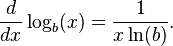
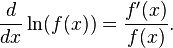
The graph of the natural logarithm (green) and its tangent at x = 1.5 (black)

Integral representation of the natural logarithm

The natural logarithm of t is the shaded area underneath the graph of the function f(x) = 1/x (reciprocal of x).
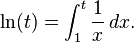


A visual proof of the product formula of the natural logarithm

The sum over the reciprocals of natural numbers,
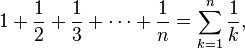
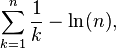
There is also another integral representation of the logarithm that is useful in some situations.

Transcendence of the logarithm
Real numbers that are not algebraic are called transcendental;[51] for example, π and e are such numbers, but is not. Almost all real numbers are transcendental. The logarithm is an example of a transcendental function. The Gelfond–Schneider theorem asserts that logarithms usually take transcendental, i.e., "difficult" values.[52]
Calculation
Logarithms are easy to compute in some cases, such as log10(1,000) = 3. In general, logarithms can be calculated using power series or the arithmetic–geometric mean, or be retrieved from a precalculated logarithm table that provides a fixed precision.[53][54] Newton's method, an iterative method to solve equations approximately, can also be used to calculate the logarithm, because its inverse function, the exponential function, can be computed efficiently.[55] Using look-up tables, CORDIC-like methods can be used to compute logarithms if the only available operations are addition and bit shifts.[56][57] Moreover, the binary logarithm algorithm calculates lb(x) recursively based on repeated squarings of x, taking advantage of the relation
Power series
- Taylor series

The Taylor series of ln(z) centered at z = 1. The
animation shows the first 10 approximations along with the 99th and
100th. The approximations do not converge beyond a distance of 1 from
the center.


- More efficient series


A closely related method can be used to compute the logarithm of integers. From the above series, it follows that:

Arithmetic–geometric mean approximation
The arithmetic–geometric mean yields high precision approximations of the natural logarithm. ln(x) is approximated to a precision of 2−p (or p precise bits) by the following formula (due to Carl Friedrich Gauss):[59][60]

Applications

A nautilus displaying a logarithmic spiral
Logarithmic scale
Main article: Logarithmic scale

A logarithmic chart depicting the value of one Goldmark in Papiermarks during the German hyperinflation in the 1920s
The strength of an earthquake is measured by taking the common logarithm of the energy emitted at the quake. This is used in the moment magnitude scale or the Richter scale. For example, a 5.0 earthquake releases 10 times and a 6.0 releases 100 times the energy of a 4.0.[68] Another logarithmic scale is apparent magnitude. It measures the brightness of stars logarithmically.[69] Yet another example is pH in chemistry; pH is the negative of the common logarithm of the activity of hydronium ions (the form hydrogen ions H+ take in water).[70] The activity of hydronium ions in neutral water is 10−7 mol·L−1, hence a pH of 7. Vinegar typically has a pH of about 3. The difference of 4 corresponds to a ratio of 104 of the activity, that is, vinegar's hydronium ion activity is about 10−3 mol·L−1.
Semilog (log-linear) graphs use the logarithmic scale concept for visualization: one axis, typically the vertical one, is scaled logarithmically. For example, the chart at the right compresses the steep increase from 1 million to 1 trillion to the same space (on the vertical axis) as the increase from 1 to 1 million. In such graphs, exponential functions of the form f(x) = a · bx appear as straight lines with slope equal to the logarithm of b. Log-log graphs scale both axes logarithmically, which causes functions of the form f(x) = a · xk to be depicted as straight lines with slope equal to the exponent k. This is applied in visualizing and analyzing power laws.[71]
Psychology
Logarithms occur in several laws describing human perception:[72][73] Hick's law proposes a logarithmic relation between the time individuals take for choosing an alternative and the number of choices they have.[74] Fitts's law predicts that the time required to rapidly move to a target area is a logarithmic function of the distance to and the size of the target.[75] In psychophysics, the Weber–Fechner law proposes a logarithmic relationship between stimulus and sensation such as the actual vs. the perceived weight of an item a person is carrying.[76] (This "law", however, is less precise than more recent models, such as the Stevens' power law.[77])Psychological studies found that individuals with little mathematics education tend to estimate quantities logarithmically, that is, they position a number on an unmarked line according to its logarithm, so that 10 is positioned as close to 100 as 100 is to 1000. Increasing education shifts this to a linear estimate (positioning 1000 10x as far away) in some circumstances, while logarithms are used when the numbers to be plotted are difficult to plot linearly.[78][79]
Probability theory and statistics

Three probability density functions (PDF) of random variables with log-normal distributions. The location parameter μ,
which is zero for all three of the PDFs shown, is the mean of the
logarithm of the random variable, not the mean of the variable itself.

Distribution of first digits (in %, red bars) in the population of the 237 countries of the world. Black dots indicate the distribution predicted by Benford's law.
Logarithms also occur in log-normal distributions. When the logarithm of a random variable has a normal distribution, the variable is said to have a log-normal distribution.[81] Log-normal distributions are encountered in many fields, wherever a variable is formed as the product of many independent positive random variables, for example in the study of turbulence.[82]
Logarithms are used for maximum-likelihood estimation of parametric statistical models. For such a model, the likelihood function depends on at least one parameter that must be estimated. A maximum of the likelihood function occurs at the same parameter-value as a maximum of the logarithm of the likelihood (the "log likelihood"), because the logarithm is an increasing function. The log-likelihood is easier to maximize, especially for the multiplied likelihoods for independent random variables.[83]
Benford's law describes the occurrence of digits in many data sets, such as heights of buildings. According to Benford's law, the probability that the first decimal-digit of an item in the data sample is d (from 1 to 9) equals log10(d + 1) − log10(d), regardless of the unit of measurement.[84] Thus, about 30% of the data can be expected to have 1 as first digit, 18% start with 2, etc. Auditors examine deviations from Benford's law to detect fraudulent accounting.[85]
Computational complexity
Analysis of algorithms is a branch of computer science that studies the performance of algorithms (computer programs solving a certain problem).[86] Logarithms are valuable for describing algorithms that divide a problem into smaller ones, and join the solutions of the subproblems.[87]For example, to find a number in a sorted list, the binary search algorithm checks the middle entry and proceeds with the half before or after the middle entry if the number is still not found. This algorithm requires, on average, log2(N) comparisons, where N is the list's length.[88] Similarly, the merge sort algorithm sorts an unsorted list by dividing the list into halves and sorting these first before merging the results. Merge sort algorithms typically require a time approximately proportional to N · log(N).[89] The base of the logarithm is not specified here, because the result only changes by a constant factor when another base is used. A constant factor, is usually disregarded in the analysis of algorithms under the standard uniform cost model.[90]
A function f(x) is said to grow logarithmically if f(x) is (exactly or approximately) proportional to the logarithm of x. (Biological descriptions of organism growth, however, use this term for an exponential function.[91]) For example, any natural number N can be represented in binary form in no more than log2(N) + 1 bits. In other words, the amount of memory needed to store N grows logarithmically with N.
Entropy and chaos

Billiards on an oval billiard table. Two particles, starting at the center with an angle differing by one degree, take paths that diverge chaotically because of reflections at the boundary.

Lyapunov exponents use logarithms to gauge the degree of chaoticity of a dynamical system. For example, for a particle moving on an oval billiard table, even small changes of the initial conditions result in very different paths of the particle. Such systems are chaotic in a deterministic way, because small measurement errors of the initial state predictably lead to largely different final states.[93] At least one Lyapunov exponent of a deterministically chaotic system is positive.
Fractals

The Sierpinski triangle (at the right) is constructed by repeatedly replacing equilateral triangles by three smaller ones.
Music


Four different octaves shown on a linear scale, then shown on a logarithmic scale (as the ear hears them).
![\frac{466}{440} \approx \frac{493}{466} \approx 1.059 \approx \sqrt[12]2.](http://upload.wikimedia.org/math/c/6/d/c6d3752631fb4afa55da128b026ffd7c.png)
| Interval (the two tones are played at the same time) |
1/12 tone  play (help·info) play (help·info) |
Semitone play |
Just major third play |
Major third play |
Tritone play |
Octave play |
| Frequency ratio r |  |
 |
 |
![\begin{align} 2^{\frac 4 {12}} & = \sqrt[3] 2 \\ & \approx 1.2599 \end{align}](http://upload.wikimedia.org/math/2/9/8/298410cc4cb7c9ac8668783eaf1abd78.png) |
 |
 |
Corresponding number of semitones![\log_{\sqrt[12] 2}(r) = 12 \log_2 (r)](http://upload.wikimedia.org/math/9/1/f/91fb1a1c63364fbe8a7bd22ef444afbf.png) |
 |
 |
 |
 |
 |
 |
Corresponding number of cents![\log_{\sqrt[1200] 2}(r) = 1200 \log_2 (r)](http://upload.wikimedia.org/math/0/7/9/079bdffd5365c1b0121c99bd809efd85.png) |
 |
 |
 |
 |
 |
 |
Number theory
Natural logarithms are closely linked to counting prime numbers (2, 3, 5, 7, 11, ...), an important topic in number theory. For any integer x, the quantity of prime numbers less than or equal to x is denoted π(x). The prime number theorem asserts that π(x) is approximately given by

The logarithm of n factorial, n! = 1 · 2 · ... · n, is given by

Generalizations
Complex logarithm
Main article: Complex logarithm

Polar form of z = x + iy. Both φ and φ' are arguments of z.


The illustration at the right depicts Log(z). The discontinuity, that is, the jump in the hue at the negative part of the x- or real axis, is caused by the jump of the principal argument there. This locus is called a branch cut. This behavior can only be circumvented by dropping the range restriction on φ. Then the argument of z and, consequently, its logarithm become multi-valued functions.
Inverses of other exponential functions
Exponentiation occurs in many areas of mathematics and its inverse function is often referred to as the logarithm. For example, the logarithm of a matrix is the (multi-valued) inverse function of the matrix exponential.[103] Another example is the p-adic logarithm, the inverse function of the p-adic exponential. Both are defined via Taylor series analogous to the real case.[104] In the context of differential geometry, the exponential map maps the tangent space at a point of a manifold to a neighborhood of that point. Its inverse is also called the logarithmic (or log) map.[105]In the context of finite groups exponentiation is given by repeatedly multiplying one group element b with itself. The discrete logarithm is the integer n solving the equation

Further logarithm-like inverse functions include the double logarithm ln(ln(x)), the super- or hyper-4-logarithm (a slight variation of which is called iterated logarithm in computer science), the Lambert W function, and the logit. They are the inverse functions of the double exponential function, tetration, of f(w) = wew,[108] and of the logistic function, respectively.[109]
Related concepts
From the perspective of pure mathematics, the identity log(cd) = log(c) + log(d) expresses a group isomorphism between positive reals under multiplication and reals under addition. Logarithmic functions are the only continuous isomorphisms between these groups.[110] By means of that isomorphism, the Haar measure (Lebesgue measure) dx on the reals corresponds to the Haar measure dx/x on the positive reals.[111] In complex analysis and algebraic geometry, differential forms of the form df/f are known as forms with logarithmic poles.[112]The polylogarithm is the function defined by


Tidak ada komentar:
Posting Komentar